
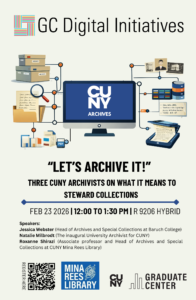
In April, the Digital Fellows were delighted to host the event “Let’s Archive It,” which brought together three archivists from across the CUNY system to discuss the exciting archival work that is happening here at the Graduate Center and across the CUNYverse. The goal of this event was to share the innovative and impactful work happening at CUNY to the GC community of students and scholars across disciplinary divides. The event kicked off with Jessica Webster, Head of Archives and Special Collections at Baruch College as well as a PhD student in history at the GC. She opened the afternoon’s conversation with a quote from archival studies scholar Michelle Caswell:
“The archive” has been deconstructed, decolonized, and queered by scholars in fields as wide-ranging as English, anthropology, cultural studies, and gender and ethnic studies. Yet almost none of the humanistic inquiry at “the archival turn” (even that which addresses “actually existing archives”) has acknowledged the intellectual contribution of archival studies as a field of theory and praxis in its own right… In essence, humanities scholarship is suffering from a failure of interdisciplinarity when it comes to archives.”
Jessica continued on to outline the lifecycle of work in archives, from acquiring new materials, to describing and making materials accessible, through preservation considerations. In addition to the substantial work and care that goes into this process, Jessica highlighted the role of subjectivity and power, and thus the constructed nature of the archival record.
Natalie Milbrodt, the inaugural University Archivist for the City University of New York (CUNY), shared initial findings from Cultivating Archives & Institutional Memory, an ambitious project to unify practice at CUNY’s 31 libraries and 100 cultural centers and institutes. The three-year, grant funded project has seen a team of over a dozen archivists work across the CUNY system to survey archival holdings at each campus. The team opened every single box (over 50,000!) and recorded information about content, unique formats, or any condition concerns. The team also surveyed digital materials, identifying over a Petabyte (1,000TB) of material. The team also works to foster appreciation of CUNY’s incredible archival collections: creating a research guide on the Red Scare at CUNY and hosting an accompanying event, contributing to scholarly publications, creating a Faculty Fellowship, and more.
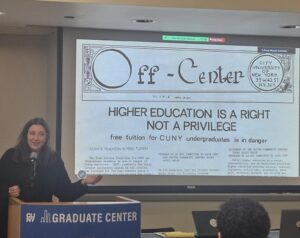 The final presenter was Roxanne Shirazi is associate professor and Head of Archives and Special Collections at the GC’s Mina Rees Library. Roxanne focussed her presentation on the CUNY Digital History Archive, and methods for activating CUNY history in CUNY classrooms. Roxanne outlined how, unlike the archival survey project discussed by Natalie, the CUNY Digital History Archive (CDHA) is a counter-institutional archive which centers the CUNY community to foreground an experiential, narrative-driven, and contextual approach to exploring CUNY’s history. It is also a digital, post-custodial archive in which materials are digitized and then returned to their owners, and prioritizes the participation of students, alumni, faculty and staff. Roxanne also discussed recent efforts to bring CUNY’s activist histories into undergraduate classrooms by building community around teaching with primary sources from CUNY archives, including creating short-term fellowships for GC doctoral students, designing open educational resources, hosting pedagogy workshops, and more.
Attended by approximately fifty people, in-person and online, the event bridged disciplinary boundaries to share the foundations and possibilities of archival practice and engagement at CUNY.

This entry is licensed under a Creative Commons Attribution-NonCommercial-ShareAlike 4.0 International license.

