
By Sam O’Hana
“Stewardship, not ownership, is the path to adulthood”
– Amy Starecheski, Ours to Lose: When Squatters Became Homeowners in New York City
68% of the world’s wealth is held in real estate, and 79% of that is in residential housing.1 In the US in the 2010s, landlords collected more than $4.5 trillion from tenants in rent payments.2 In 2024, the residential vacancy rate in New York City hit an all-time low of 1.4%,3 while homelessness in the city doubled since the pandemic to an estimated 350,000 people, including 35,000 homeless children.4
For those who rent rather than own their homes, protecting your tenancy can be a part time job. At any time you might be outbid on the rights your home by a newcomer who can afford to pay more. But this work need not happen alone. A tenants’ association– a group of tenants in a building who organize to defend their rights to affordable, stable and safe housing– redresses the power imbalance between renters and landlords, forcing owners to negotiate with a group of tenants rather than with each one on a case-by-case basis.
The corruption that is required to raise rents, evict tenants and displace longstanding communities can only function in the dark. Fraudulent deregulation of rent stabilized apartments, absence of essential repairs, and arbitrary refusal to renew leases become the norm only when landlords are not held to account by the facts of the law and of public exposure. When tenants learn their rights, they simultaneously learn to recruit the assistance of city agencies like HPD, DHCR, DOB and the FDNY to defend the integrity of their home life.
A tenants’ association website is a key tool for tenants to disrupt the narrative that speculative real estate runs on because online listings market properties as lucrative investments. A tenants association website, by showing up on internet search results, shows prospective buyers, lenders and tenants that the occupants of the building know their rights in relation to their tenancies and are willing to enforce them using all appropriate channels, including litigation if need be.
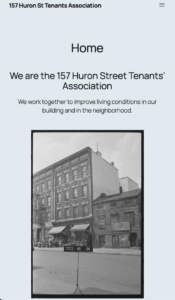
 A simple self-hosted WordPress site such as the one at https://157huronstreet.com/ makes it clear to all stakeholders– current and prospective– that the risk of attempting to harass tenants in order, for example, to empty out a building in order to “flip” it for substantial returns, is much higher than in a building where the tenants are not organized. This is because tenants can file collective complaints with the city authorities, who will in turn deploy multi-agency harassment prevention “task forces” that can issue violations for neglect and nuisances, as well as stop work orders for any illegitimate construction work.
Landlords are often unscrupulous, but they are almost always well organized. They share attorneys who know how to intimidate tenants and drag out legal claims made by tenants, bluffing their way through the courts and wasting the time and resources of the taxpayer-funded judicial system. Only by joining with each other can tenants effectively counter narratives of misinformation. It is far more effective if those counternarratives can be published online through a website because it puts on the record the issues at stake for all members of the community to see.
Many neighborhoods in New York have tenants’ associations that you can find by searching online, such as Flatbush, Crown Heights, Chinatown, Upper Manhattan, Bushwick, Southwest Brooklyn, Astoria, Ridgewood. There is also a newly emerging national Tenant Union Federation.
1. Tracy Rosenthal & Leonardo Vilchis. Abolish Rent, Haymarket Books, 2024.
2. Ibid.
3. NYC Housing Preservation and Development, New York City’s Vacancy Rate Reaches Historic Low of 1.4 Percent, Demanding Urgent Action & New Affordable Housing, February 8, 2024.
4. Coalition for the Homeless, Basic Facts About Homelessness: New York City, January 2026.

This entry is licensed under a Creative Commons Attribution-NonCommercial-ShareAlike 4.0 International license.

