
This post is written by guest contributor Nicole Walker.
In Base44’s recent Super Bowl advertisement, office workers who have never coded before suddenly realize they can use A.I. to create apps. Drunk on power, they build apps to cater to niche interests, like protein tracking and dating apps for dogs. While my own experience using Claude Code involved much more time and many more emails to tech support than were strictly television-friendly, the fact that I—a person unsure which remote controls the television in her own apartment—was able to build a digital tool (one complex enough to require an API key, no less!) is proof that Claude Code is, in fact, incredibly empowering.
I made my tool to solve a problem familiar to writing teachers. I teach ENG 111, Lehman’s mandatory first-year composition course. Because high school English teachers must prepare students for state tests, first-year students tend to think of writing as a means of assessment rather than a forum for exploring ideas. Every semester, I attempt to convince students that I am genuinely interested in their thoughts—that applying their minds (and not anticipating mine) is the point. And every semester, long weeks go by before my students believe me. My most successful efforts toward this end have always involved using the products of large language models as examples of the generic “mid” writing that students should avoid. With this in mind, I began this past semester with a unit titled “Defining the Human in the Age of A.I.” I also made my tool, Seeing the Difference: A Human vs. A.I. Visualization Tool.
It’s called “vibe coding”—this practice of describing to a large language model what you would like it to create and then watching it build it for you. For smaller, simpler apps, it can take as little as thirty seconds. Building my tool was, as I have already alluded, not entirely smooth, in part because I started with the free version of ChatGPT, only moving to Claude Code on the advice of Stefano Morello at the New Media Lab. I thought I had created a working prototype long before I actually had; the program had created a folder of random words it was pulling from rather than connecting to the internet and selecting the one hundred or so words most associated with the paper topic. However, once I got that sorted out, the tool was quite helpful.
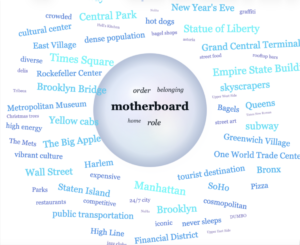
In its most recent iteration, students populate fields with the paper topic and with the five or so words most significant to their own treatment of that topic. Choosing words to represent their content is, of course, its own exercise and assessment. Once this is completed, students click on a button labeled “Generate,” and a bubble appears with their own “significant words” inside it. A.I. then fills the field surrounding the bubble with the words most frequently associated with the paper topic.
Something about the exercise, whether it was the resulting visual representation, the novelty of the tool, or the fact that I was willing to try something new with them—got through to my students more quickly than any of my previous exhortations to “use your own brain” or “think of your own associations.” Or so it would seem. I have students write for the first twenty minutes of every class, and in the last two months, I have watched them progress more rapidly than the students of previous semesters, moving from the generic, unnatural-sounding text they produced for state tests to writing that is looser and richer—that takes interesting risks and detours and engages their own thoughts and ideas. Since the only substantive change I have made is introducing the tool, I feel comfortable giving Claude the credit.
There is, of course, great irony in the fact that I used A.I. to build a tool illustrating the importance of using one’s own mind. I have no defense for this unless it is the difficulty I have in imagining myself accomplishing it any other way. I wanted to make the tool for this semester’s students, not the students I might have years from now when I have mastered the required coding. I wanted Betzy, Mylik, and Elian to understand that their ideas mattered and belonged in the classroom. And now they do. While A.I. is problematic for a whole host of reasons, I am convinced that the technology that will inevitably shape our future needs to be in the hands of people who feel the weight of that responsibility, people who center equity, inclusion, and social justice in their work, like many of my peers at the Graduate Center.

This entry is licensed under a Creative Commons Attribution-NonCommercial-ShareAlike 4.0 International license.

