
This post is written by guest contributor Jonah Brucker-Cohen from Lehman College. Connect with Jonah Brucker-Cohen at [email protected]
A.I. Meets Critical Media Art is a series of eight distinct projects of which five of them will be detailed here. These works build off of my previous work in the area of A.I. by maintaining the focus on questioning not only the results of A.I. but the medium itself.
- AGGRO-MOUSE
AGGRO-MOUSE is a hacked computer mouse infused with A.I. that intentionally limits a user’s ability to use their computer if conditions are met. For instance, opening the same folder or drive over and over again instructs AGGRO-MOUSE to impede your ability to move the mouse towards that folder or drive on the desktop. The mouse monitors user habits and imposes restrictions when repetitive patterns are detected. When these conditions are met, the AGGRO-MOUSE disrupts the physical movement of the cursor, introducing friction into the user’s interface experience. This design probes the boundaries between user autonomy, machine agency, and the psychological impact of disrupted routines in human-computer interaction.
- EXPRESSION OF MEMORY
“Expression of Memory” is a calendar with A.I. that will only show important dates from someone’s life that correspond to their current emotional, facial expression. One begins by training the calendar on important dates from their life based on their emotional responses (happy, sad, angry, fearful, surprised, disgusted, neutral, and confused) to those dates. Once trained, the calendar detects their emotional state based on their facial expression and responds with the date and name of the event in their life that corresponds to their current emotional state. For instance, if one smiles at the screen, dates and media related to “happy” moments in their life will emerge such as a past birthday, favorite vacation, wedding day, graduation, or other joyful moments of their life. If crying or frowning, sad days materialize such as a death in the family, when an injury occurred, or when they lost their job.For decades, theorists have studied how emotional states can trigger memories in individuals. “Expression of Memory” functions as an emotional detection system that can tell how a person is feeling based on their facial expression and recall a memory that corresponds to this feeling.
- SubTask
“Subtask” is a media artwork that visually marks parts of websites that rely on crowd labor or data-labeling work and use cloud labor sites like Amazon Mechanical Turk, Appen, Scale A.I., and others to create the site. The project overlays data such as pay rates, testimonials, and ethical ratings from public datasets and activist sources related to each website that it is asked to check. The goal of the project is to critically examine how the Internet is largely built by underpaid laborers and A.I. software and how the web exists as another form of control to get large online presences built. “Subtask” is an open source extension to the popular browser, Google Chrome, allowing anyone to install it and search for invisible forms of labor across any website that they view. It works by crawling crowd and A.I. worker sites like Appen, Mechanical Turk, and Scale A.I. for user testimonials about how much was paid to workers to complete menial tasks such as labelling images, resizing design elements, and adding statistical data to documents. Once installed, the extension places “green” flags next to content that was created by online “clickworkers” and a testimonial of their activity on the site to expose these blatantly abusive labor practices.
- Weather The Times
“Weather The Times” is an open source Chrome extension with A.I. that filters which New York Times articles can be read based on the local weather of where the user is situated. By dynamically fetching real-time weather data and conducting sentiment analysis of articles, “Weather The Times” nudges a viewer’s news diet to match the mood of the skies above: On sunny days, only lighthearted and uplifting stories are accessible such as lifestyle, food, and travel. On rainy or stormy days, the extension restricts access to more serious and somber news about world events, crises, and politics. Articles that don’t fit the current weather mood are visually blurred and overlaid with poetic messages explaining their temporary inaccessibility. This project is a critique of how external forces, like the environment or algorithmic curation shape our information consumption, questioning our passive relationship to news and the emotional filters that color our perception of the world.
- Not THIS
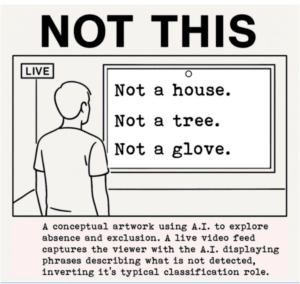
“Not THIS” is a conceptual and experiential artwork that engages both A.I. and Baudrillardian theory to explore absence, exclusion, and the poetics of negation. A live camera feed captures the viewer and their surroundings, but the AI does not identify what is present, instead, it generates text describing what is not detected, with phrases such as “Not a person. Not a tree. Not memory.” By refusing to recognize reality directly, the A.I. inverts its conventional role as an objective classifier, creating a tension between what is visible and what is acknowledged. The piece is based on Baudrillard’s notion of simulacra and hyper reality 1, in which signs and representations can replace or precede reality. Here, the A.I.’s negations produce a hyperreal commentary: the viewer exists in the video feed yet is rendered partially absent in the textual output. This inversion exposes the limitations of machine perception while turning A.I. into a poetic device, generating meaning through omission rather than factual identification. “Not This” reveals the limits of machine perception. The A.I. refuses to affirm what it sees, instead naming what is not present, echoing Magritte’s paradox of language and image. Both works question the authority of vision and truth, inviting viewers to confront the instability of meaning, and how representation, whether painted or algorithmic constructs, rather than captures, the real.
Conclusion
Despite the seemingly inevitability of A.I. as an all-encompassing force for content generation and online deception such as the ease in creating “fake news” or celebrity impersonations, the potential for artists to subvert these systems is exponential. Instead of merely using an A.I. system to create something it was intended to make, my intention is to subvert the software itself by using it to critically examine its own use. The projects outlined above along with the previous projects help prove that questioning these platforms is the ultimate method of provoking new understandings of just how much A.I. has infiltrated our daily lives and how its existence is still one that should be questioned and hacked.
This full paper was published in the proceedings of EVA London 2026 – http://www.eva-london.org/

This entry is licensed under a Creative Commons Attribution-NonCommercial-ShareAlike 4.0 International license.

